
Audiophile PCIe USB host card
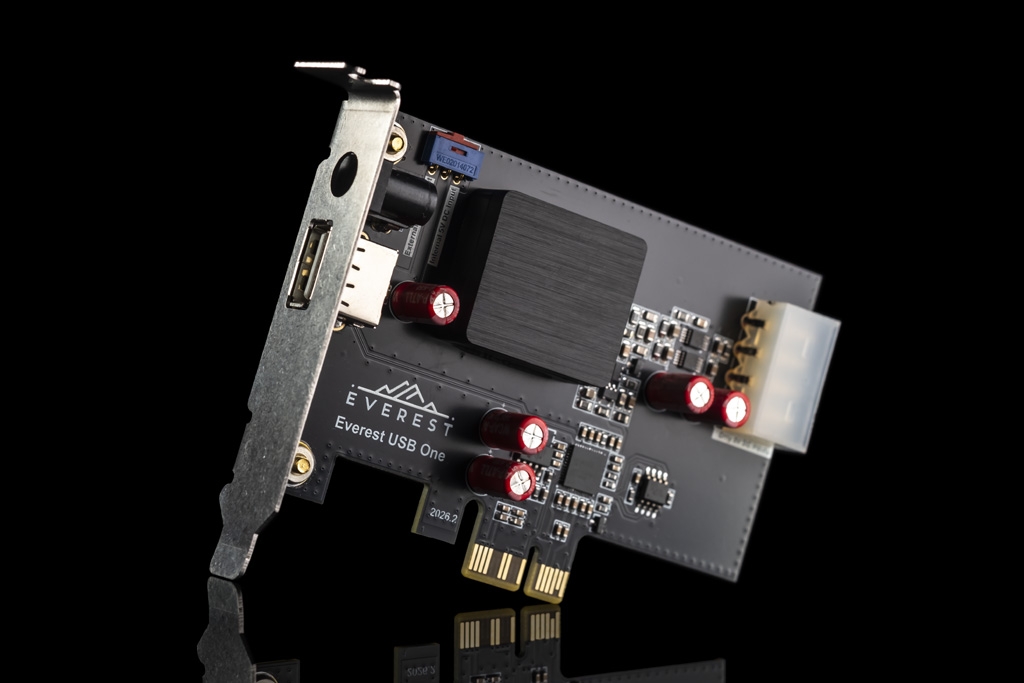
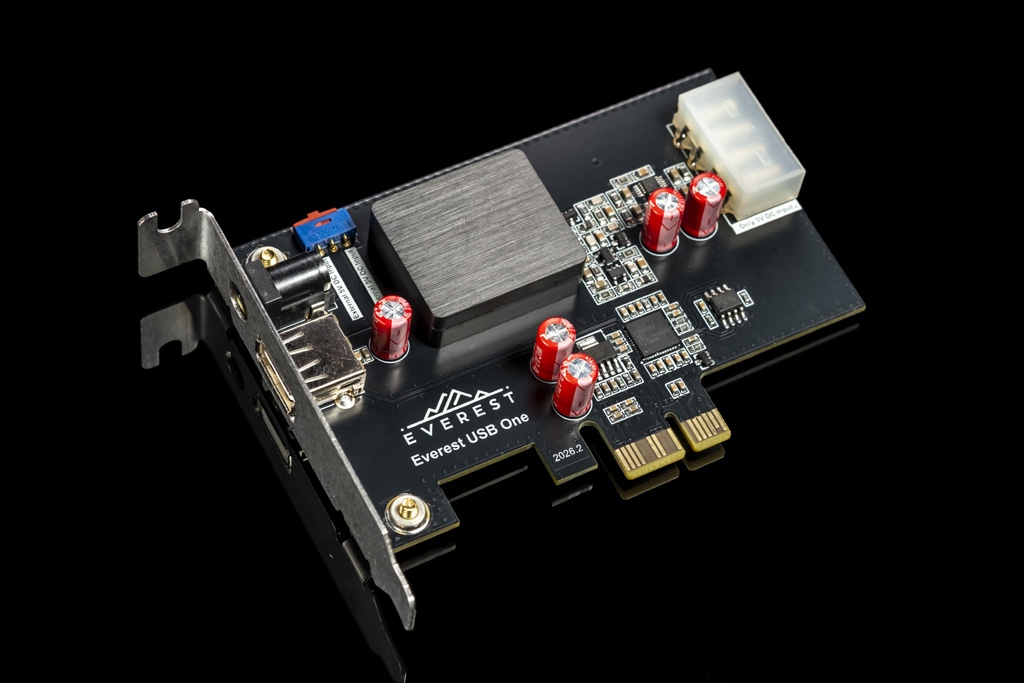
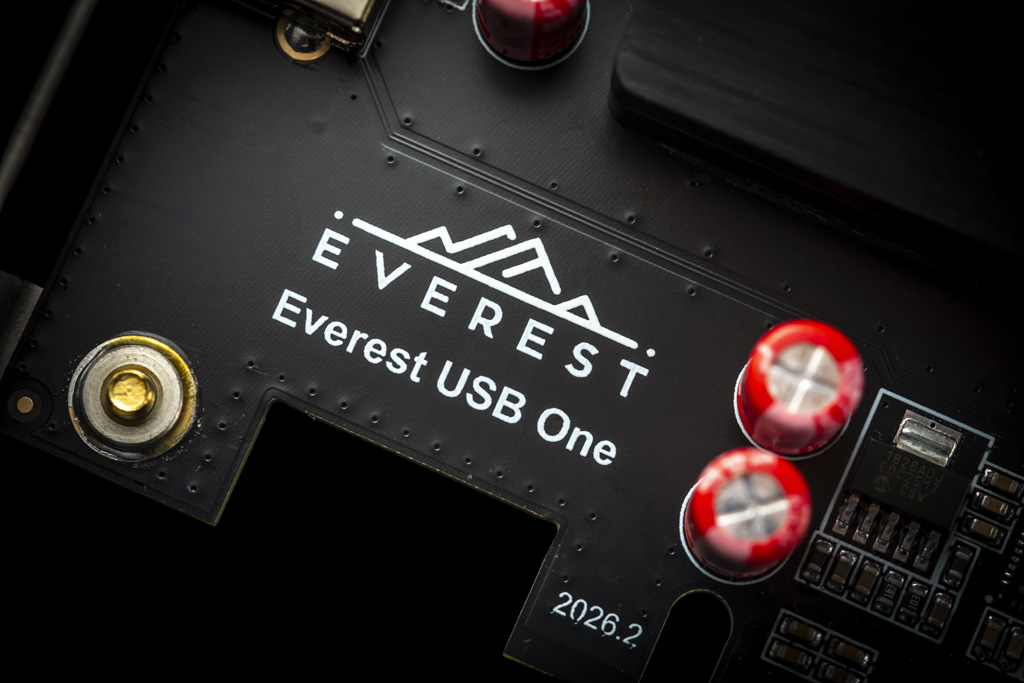
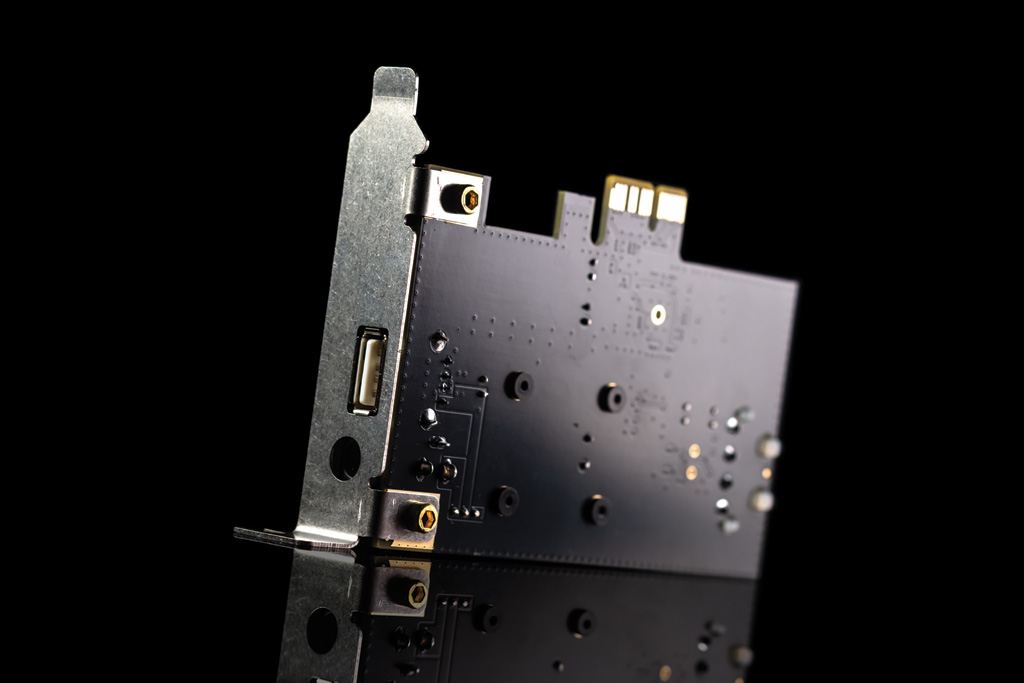
Everest USB One is a dedicated PCIe USB host card engineered for high-end digital audio playback. Designed to provide a cleaner, more stable and lower-noise USB output than standard computer ports, it combines a low phase noise crystal oscillator, state-of-the-art ultra-low-noise LT3042 voltage regulators and a carefully optimized PCB layout to create a better operating environment for USB Audio transmission.
Clocking
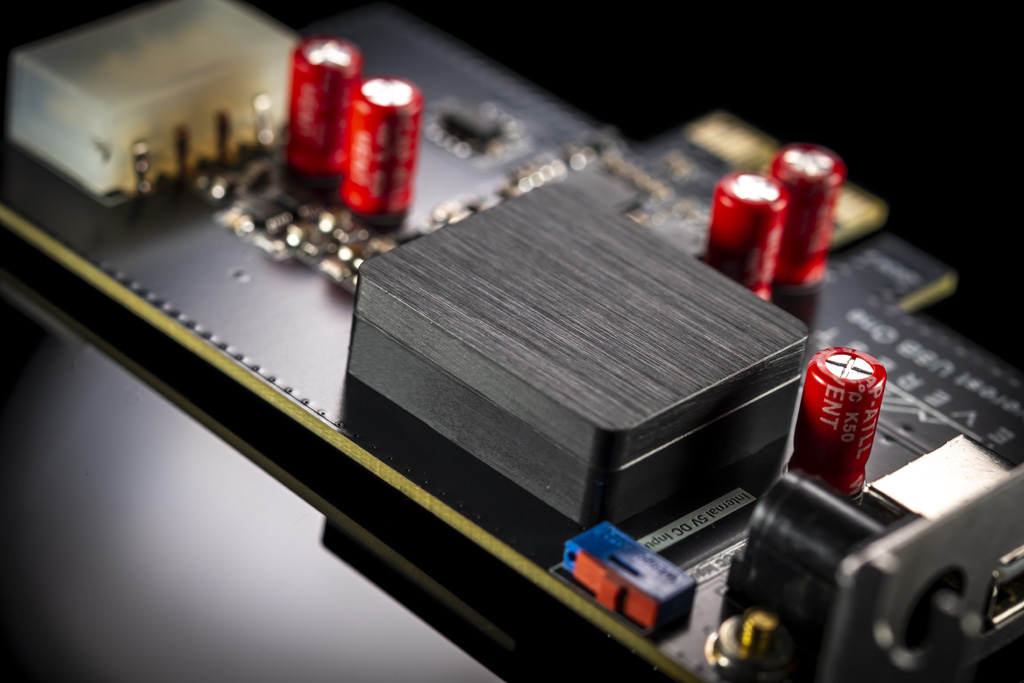
Low phase noise SC-cut crystal oscillator in a shielded, potted enclosure.
Power
State-of-the-art, ultra-low-noise LT3042 voltage regulators.
Flexible power
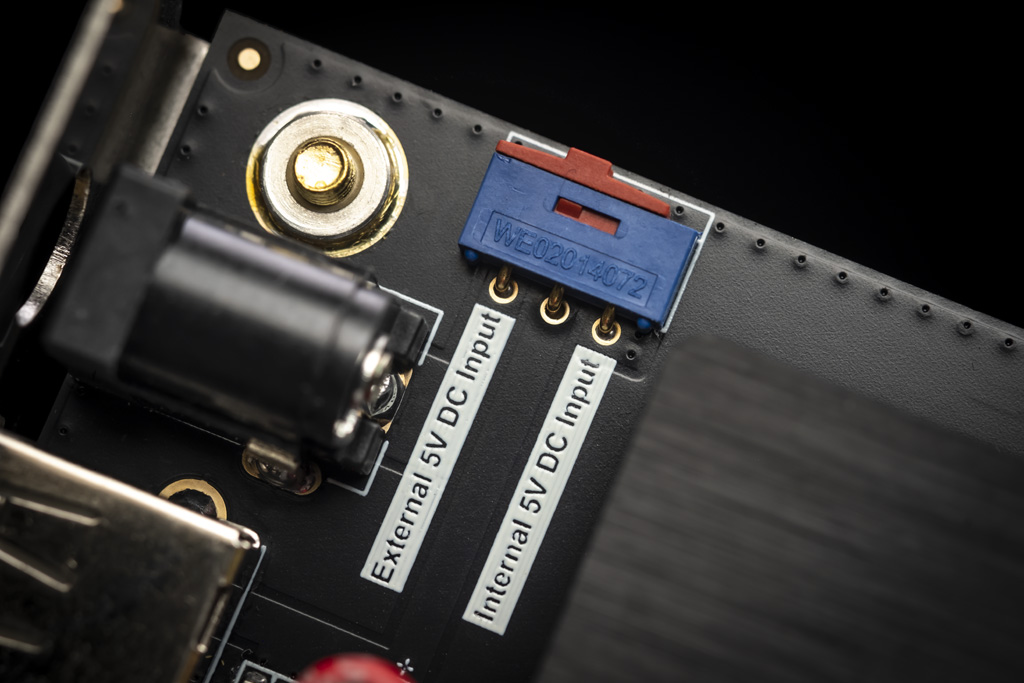
Powered internally or from an external 5 V DC supply.
Compatibility
Plug & play on Windows, Linux and macOS — no drivers needed.
Free worldwide shipping
All prices include VAT.
Why a USB Card Matters
In theory, USB Audio is a digital transmission. With most modern DACs operating in asynchronous mode, the DAC — not the computer — controls the playback rate using its own internal audio clocks. This often leads to the assumption that the USB card inside the computer should have no influence on sound quality.
In practice, the situation is more complex. A USB host card does not directly clock the DAC, but it remains an active part of the transmission chain — controlling the USB bus, packet timing, frames and microframes, communication with the USB receiver inside the DAC, and the physical layer of the signal sent through the USB cable.
For this purpose, the USB controller uses its own reference clock. In Everest USB One, this clocking environment has been carefully optimized to support stable operation of the USB controller and reduce unwanted high-frequency noise generated by the interface.
Asynchronous Does Not Mean Perfect
Asynchronous USB Audio does not mean that timing no longer matters. USB transmission still operates within a precise time structure, using packets, microframes and isochronous transfers.
Asynchronous mode simply means that the DAC controls the rate at which audio samples are consumed and sends feedback to the host. It does not mean that signal quality, packet stability, power noise or interference generated by the USB host controller become irrelevant.
By improving the quality of the USB host environment, Everest USB One helps reduce the electrical noise and timing-related disturbance that can be passed toward the DAC through the data lines, ground connection, cable shield and USB power line.
Clean Power for the Connected DAC
In many DACs, the USB +5V power line is not used only for device detection. It may also power the USB receiver, interface circuitry, isolators, input logic or local voltage regulators on the USB input board.
In many designs, the USB input board is also where the audio clocks are located, because the USB receiver outputs an I²S signal to the main DAC section after receiving the data stream.
This means the quality of the USB power environment can influence not only the USB communication itself, but also the noise level and stability of critical circuits inside the DAC.
SC-Cut Low Phase Noise Oscillator
The USB controller requires its own reference clock. It does not replace or control the DAC’s internal audio clock — instead it provides the timing reference for the USB controller itself, influencing the stability of the USB interface, the behavior of internal PLLs and the high-frequency noise generated by the host controller.
Everest USB One uses an SC-cut crystal oscillator selected for its excellent frequency stability and low phase noise performance. Compared with more common AT-cut crystals, the SC-cut’s double-rotated quartz cut offers lower sensitivity to mechanical stress, improved thermal behavior and lower acceleration sensitivity, helping reduce the influence of vibration and microphonic effects. It also improves separation between the desired vibration mode and unwanted spurious modes, lowering close-in phase noise.
The oscillator is enclosed in a dedicated CNC-machined metal enclosure for mechanical stability, shielding and protection from the electrically noisy environment inside a computer. It is additionally potted with a special damping compound to suppress high-frequency microphonic effects, helping the oscillator maintain cleaner, more stable operation under real-world conditions.
Flexible Power Input
Everest USB One can be powered either from inside the computer or server, or from an external 5V DC power supply.
This gives you the flexibility to choose a simple internal installation, or a more advanced setup using a dedicated external linear power supply for the lowest possible noise floor.
Plug & Play Compatibility
Everest USB One is compatible with Windows, Linux and macOS. The card is plug & play and requires no dedicated drivers.
Both full-height and low-profile brackets are available, making installation easy in a wide range of audio servers and computer-based playback systems.